HSP & Neurodivergence: Unraveling Overlaps & Distinctions
If you’ve always sensed you experience the world more deeply—noticing subtleties others miss or needing quiet after busy days—you’re not alone. This sense of being "different" often leads to self-discovery, where terms like Highly Sensitive Person (HSP) and neurodivergence emerge. Understanding what they mean, and how they relate to each other, is the first step toward clarity.
Are you a Highly Sensitive Person, neurodivergent, or perhaps both? This question is more than just finding a label; it’s about understanding your unique wiring so you can thrive. This article will help you unravel the key differences and overlaps between these concepts. We will explore the scientific foundations of HSP, the broad spectrum of neurodivergence, and how to tell them apart from conditions like Autism and ADHD.
Gaining clarity is the first step toward self-acceptance. To begin your journey of discovery, you can explore your own traits with a comprehensive HSP test based on the foundational research in this field.
Understanding the Landscape: What is HSP and Neurodivergence?
Before we can compare HSP and neurodivergence, it's essential to understand what each term means on its own. They are not interchangeable, and each describes a distinct way of experiencing the world.
The Highly Sensitive Person (HSP): A Trait, Not a Disorder
The term "Highly Sensitive Person" was introduced by psychologist Dr. Elaine N. Aron in the 1990s. It’s crucial to know that being an HSP is not a medical diagnosis or a disorder. It is an innate personality trait, also known as Sensory Processing Sensitivity (SPS), found in about 15-20% of the population.
This trait is defined by four key characteristics, often remembered by the acronym DOES:
- D - Depth of Processing: HSPs think deeply about everything. They process information and experiences more thoroughly, often connecting and comparing them to past events.
- O - Overstimulation: Because they process so much, HSPs can become easily overstimulated by busy environments, loud noises, or intense social situations.
- E - Emotional Responsiveness & Empathy: HSPs feel emotions, both positive and negative, very strongly. They also have a high level of empathy, often sensing the feelings of those around them.
- S - Sensitive to Subtleties: HSPs are highly attuned to small details in their environment, such as changes in lighting, slight shifts in someone's tone of voice, or subtle smells.
What Does "Neurodivergent" Truly Mean? A Broad View
"Neurodivergent" is a non-medical umbrella term that describes people whose brains develop or work differently from what is considered "neurotypical." It embraces the idea that variations in brain function are natural and not necessarily deficits.
Neurodivergence covers a wide range of conditions, each with its own unique set of characteristics. Some of the most well-known neurodivergent identities include:
- Autism Spectrum Disorder (ASD)
- Attention-Deficit/Hyperactivity Disorder (ADHD)
- Dyslexia
- Tourette Syndrome
- Dyspraxia
The neurodiversity movement advocates for celebrating these differences rather than viewing them as problems to be fixed. It emphasizes that society should adapt to accommodate these diverse ways of thinking and perceiving the world.
HSP vs. Neurodivergence: Identifying Key Overlaps and Distinctions
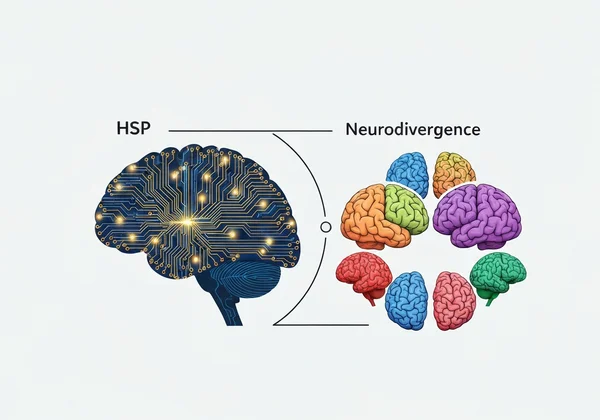
This is where things can get confusing. Many people who identify as HSP also see themselves as neurodivergent, and there are valid reasons for this. Let's explore the connections and the critical differences.
Where HSP Traits and Neurodivergent Experiences Intersect
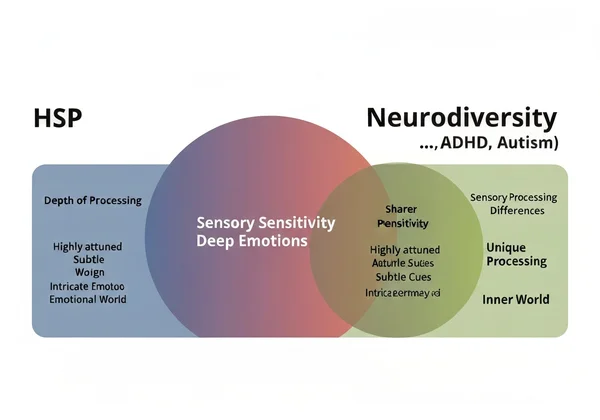
The most significant overlap lies in sensory sensitivity. Both HSPs and many neurodivergent individuals, especially those with Autism or ADHD, can experience sensory overload. A crowded mall, a loud concert, or even the texture of a clothing tag can be intensely uncomfortable or distressing.
Other shared experiences can include:
- Intense Emotions: Feeling emotions deeply is common.
- Need for Downtime: Both groups often require more time alone to decompress and recover from overstimulation.
- Feeling Misunderstood: Many HSPs and neurodivergent people grow up feeling "different" or out of place.
These similarities are why many people wonder if they are one, the other, or both.
The Unique Markers: What Sets HSP Apart? (The DOES Model Revisited)
While the overlaps are real, the core definitions provide clarity. The HSP trait is specifically defined by the DOES model. The combination of all four elements, especially Depth of Processing and Sensitivity to Subtleties, is unique to HSPs.
For example, an HSP might deeply ponder a conversation for hours, noticing subtle cues in body language that others missed. While a neurodivergent person might also be sensitive, their experience is defined by a different set of criteria. The root cause of the behavior is often different.
Is HSP the Same as Being Neurodivergent? Exploring the Nuance
This is a topic of ongoing discussion. Many experts and individuals in the community consider the HSP trait a form of neurodivergence. This is because it represents a brain that functions differently from the majority. From this perspective, being highly sensitive means you are part of the beautiful spectrum of neurodiversity.
However, it's important to distinguish HSP from specific neurodevelopmental conditions like Autism or ADHD. These are clinical diagnoses with distinct diagnostic criteria. HSP is a personality trait. You can be an HSP without having a diagnosable condition, or you can be an HSP and also be autistic or have ADHD. The experiences can co-exist and influence each other.
Deep Dive: HSP, Autism, and ADHD – Common Confusion Points
The overlap between HSP, Autism, and ADHD causes the most confusion. Understanding the key distinctions is empowering and can guide you toward the right resources and support.
Differentiating HSP from Autism Spectrum Disorder (ASD)
While both HSPs and autistic individuals can be highly sensitive to sensory input, their social and emotional experiences often differ.
- Social Motivation: HSPs typically desire social connection and have strong intuitive empathy (they "feel with" others). They may withdraw from social events because they feel overwhelmed, not because they lack the desire or skill to connect. In contrast, some autistic individuals may have different ways of processing social cues and relating to others.
- Empathy: HSPs are known for high levels of affective (emotional) empathy. Autistic individuals experience empathy too, but may struggle more with cognitive empathy (theorizing what others are thinking) or express it differently.
- Routine and Interests: A preference for routine and deep, specific interests are hallmark traits of Autism. While HSPs appreciate calm and predictability, they don't necessarily have the same need for sameness as some on the autism spectrum.
Untangling HSP and Attention-Deficit/Hyperactivity Disorder (ADHD)
The confusion between HSP and ADHD often comes from the shared experience of being easily distracted or overwhelmed.
- Root of Distraction: For an HSP, difficulty concentrating is often caused by overstimulation. The room might be too loud, the lights too bright, or there's simply too much emotional input. For someone with ADHD, challenges with concentration are typically rooted in differences in executive functions like attention regulation and impulse control.
- Hyperactivity vs. Overarousal: An HSP who is overstimulated might appear fidgety, anxious, or "buzzy," which can look like hyperactivity. However, this is a reaction to an overloaded nervous system. In ADHD, hyperactivity is often a more persistent state related to the brain's need for stimulation.
If you suspect you have traits of more than one, a helpful first step is to isolate and understand your sensitivity. A reliable HSP test offers clarity. It helps you understand your sensitivity baseline.
Thriving Strategies for the Highly Sensitive & Neurodivergent
Ultimately, labels are only useful if they lead to better self-understanding and a happier life. Whether you identify as an HSP, neurodivergent, or both, the goal is to embrace your unique wiring.
Self-Compassion and Acceptance: Embracing Your Unique Wiring
The first and most important step is to stop judging yourself for being "too sensitive" or "different." Your brain is not broken; it simply processes the world in a unique way. This perspective brings strengths like creativity, empathy, depth, and intuition.
Learning about your traits is an act of self-compassion. It gives you a language to describe your experience and helps you realize you are not alone. This knowledge is the foundation for building a life that honors your needs.
Building Your Support System: Relationships, Work, and Environment
Once you understand your needs, you can start making conscious choices to support your well-being.
- Manage Your Environment: Identify your triggers for overstimulation. This could mean using noise-canceling headphones, creating a calm space at home, or limiting time in chaotic environments.
- Communicate Your Needs: Teach the people in your life about your traits. Explaining that you need quiet time to recharge isn't being difficult; it's a legitimate need for your nervous system.
- Choose Your Work Wisely: Many HSPs and neurodivergent individuals thrive in roles that value deep thinking, creativity, and empathy, and that offer a calm work environment.
Understanding your specific sensitivities is key to this process. Taking the time for a detailed self-discovery can provide the insights needed to build a life that truly fits you.

Beyond Labels: Embracing Your Identity and Seeking Further Insight
Understanding your sensitivity isn’t about fitting into a box. It’s about unlocking tools to thrive. While HSP shares traits with neurodivergent conditions like Autism and ADHD, it is a distinct personality trait defined by Dr. Aron's DOES model. These labels are not meant to confine you but to empower you with understanding.
Recognizing your traits is the first step to self-acceptance. It lets you build a life aligned with your true nature. You can stop fighting against your wiring and start working with it, harnessing your sensitivity as a powerful gift.
If you are ready to gain deeper insight into your own personality, the most reliable starting point is to see if you align with the traits of a Highly Sensitive Person.
Start the Official HSP Test today to explore your sensitivity and begin your journey toward greater self-understanding.
Disclaimer: This article is for informational purposes only and does not constitute medical advice. The HSP test is an educational tool, not a clinical diagnostic instrument. If you have concerns about Autism, ADHD, or other conditions, please consult a qualified healthcare professional.
Frequently Asked Questions About HSP and Neurodivergence
Is HSP the same as being neurodivergent?
Many people consider the HSP trait a form of neurodivergence because it describes a brain that processes information differently from the neurotypical majority. However, unlike Autism or ADHD, HSP is not a clinical diagnosis but a personality trait.
Is HSP considered autism or a symptom of ADHD?
No. HSP is a distinct trait and is not a form of Autism or a symptom of ADHD. While a person can be both an HSP and autistic, or an HSP with ADHD, they are separate concepts with different underlying characteristics.
Could My Sensitivity Be Misdiagnosed? HSP vs. Anxiety, Introversion & Trauma
Because of the overlap in symptoms like emotional intensity and withdrawal, HSP can sometimes be mistaken for social anxiety, introversion, or even the effects of trauma. A key differentiator is that HSP is an innate trait you are born with.
How can I confirm if I am a Highly Sensitive Person?
The best way to start is by learning about the core traits and seeing how they resonate with your life experiences. The most reliable first step is to take a well-researched assessment based on Dr. Elaine N. Aron's work. You can take the free test on our website to get immediate insight into your sensitivity level.