What Is a Hypersensitive Person in Psychology
A hypersensitive person is usually someone who reacts more strongly than average to emotional, social, or sensory input. In psychology-adjacent writing, the more precise term is often highly sensitive person, or HSP: a person high in sensory processing sensitivity. That does not mean weakness, drama, or a medical diagnosis. It means the nervous system may notice more, process more deeply, and become overloaded sooner. If you are trying to make sense of your own reactions, Hsptest.org offers HSP self-reflection resources that can help you explore the trait without turning it into a clinical label.

The Simple Meaning of a Hypersensitive Person
In everyday speech, "hypersensitive" can sound negative. People may use it when they think someone is easily hurt, too reactive, or overwhelmed by things other people seem to ignore. That casual use can be confusing because it mixes several different experiences together.
In psychology, a hypersensitive person may be someone with unusually strong sensitivity to emotional cues, criticism, conflict, light, sound, texture, social pressure, or internal sensations such as hunger and fatigue. The experience can include both intensity and depth. You might not simply hear a loud room; you may track every voice, feel the mood of the room, and need extra time afterward to reset.
For HSP-related content, "highly sensitive person" is usually a more respectful and accurate phrase. It frames sensitivity as a temperament trait rather than a flaw. It also reminds readers that sensitivity can bring challenges and strengths at the same time.
Why Highly Sensitive Person Is the More Precise Term
The HSP concept is commonly linked with sensory processing sensitivity, or SPS. SPS describes a tendency to process sensory, emotional, and social information deeply. A highly sensitive person may notice subtleties, respond strongly to the emotional tone of a situation, and need quieter recovery time after busy or intense experiences.
The word "hypersensitive" can still be useful as a search term because many people use it before they know the HSP vocabulary. But it can also imply that the person is overreacting. "Highly sensitive person" is usually better when the goal is self-understanding rather than judgment.
One important boundary: HSP is not the same thing as anxiety, autism, ADHD, sensory processing disorder, trauma response, or a personality disorder. Some experiences can overlap, especially around overstimulation or emotional intensity, but the categories are not interchangeable. If sensitivity comes with severe distress, impaired daily functioning, panic, self-harm thoughts, or relationship instability, it is wise to involve a qualified mental health professional.
What Hypersensitivity Can Look Like Day to Day
Highly sensitive person symptoms are more accurately described as traits or patterns, because HSP is not an illness. The patterns often show up in a few everyday areas.
Emotional and social sensitivity
You may pick up on shifts in tone, facial expression, or group tension quickly. A small criticism can linger because your mind keeps replaying what happened. You might feel deeply moved by music, stories, art, kindness, or someone else's distress. This can support empathy and careful communication, but it can also make conflict feel draining.
Sensory sensitivity
Bright lights, overlapping noise, strong smells, scratchy clothing, busy stores, or crowded transit may feel like too much. The issue is not that the stimulus is objectively unbearable for everyone. It is that your system may reach overload faster, especially when several inputs arrive at once.
Deep processing
Highly sensitive people often think carefully before acting. They may compare options, anticipate consequences, and notice small details others miss. This can be valuable in creative work, caregiving, teaching, analysis, and problem solving. It can also become tiring when every choice feels heavy.
Recovery needs
After a demanding social day, a noisy event, or emotionally intense work, you may need quiet time that feels non-negotiable. That need is not laziness. It may be your nervous system returning to baseline. A free HSP self-test can be a gentle way to compare these patterns with common HSP experiences while remembering that a self-test is only educational.
The 4 Traits Often Used to Explain High Sensitivity
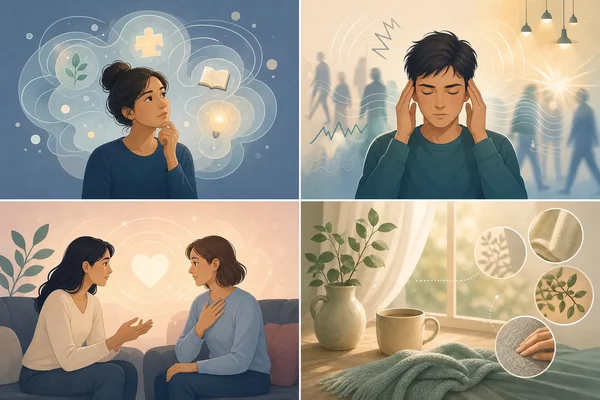
Many HSP educators describe high sensitivity through four broad traits, often summarized with the DOES model. These traits are not a rigid checklist, but they can help you understand what is happening.
Depth of processing
Depth of processing means you take in information and turn it over carefully. You may notice connections, meanings, and possible outcomes that other people skip. This can make you thoughtful and conscientious, but it may also make decisions slower.
Overstimulation
Overstimulation happens when the amount of input exceeds your capacity to process it comfortably. It can look like irritability, mental fog, tiredness, a desire to leave, or a strong need for quiet. The goal is not to avoid life; it is to learn your limits and plan recovery before overload builds.
Emotional responsiveness and empathy
High sensitivity often includes strong emotional responses to both positive and negative experiences. You may feel joy, beauty, sadness, tension, and compassion vividly. This trait can support close relationships, but it needs boundaries so you do not become responsible for everyone else's mood.
Sensitivity to subtleties
Sensitivity to subtleties means you notice details: a slight change in lighting, a small expression on a friend's face, a shift in a meeting, or the texture of a room. These details can enrich life, but they can also add up when your environment is constantly busy.
Is a Highly Sensitive Person a Diagnosis or a Real Thing
One of the most common questions is whether HSP is a diagnosis or a real thing. The safest answer is: high sensitivity is a real personality and temperament concept discussed in psychological research, but it is not a medical diagnosis.
That distinction matters. A medical diagnosis is used by clinicians to classify health conditions and guide care. HSP describes a sensitivity trait. It may help you understand why you respond strongly to stimulation, but it should not be used to explain every difficulty or replace professional evaluation when symptoms are intense, persistent, or disruptive.
It also matters because HSP can be misunderstood in both directions. Some people dismiss it as an excuse. Others use it too quickly as an all-purpose identity. A balanced view is more useful: high sensitivity may describe part of how your nervous system handles information, and your environment, stress level, sleep, relationships, health, and past experiences can all shape how intense it feels.
If you are wondering whether high sensitivity is a real thing for you, look for patterns over time rather than one emotional day. Notice whether you have been sensitive across many settings, whether both positive and negative experiences affect you deeply, and whether recovery time consistently helps.
Highly Sensitive Person Problems and Support Options
Highly sensitive person problems usually come from the fit between the person and the environment. A highly sensitive person may do well in calm, respectful, meaningful settings and struggle in chaotic, harsh, or constantly rushed ones. Common challenges include emotional exhaustion, sensory overload, trouble saying no, feeling misunderstood, and needing more downtime than peers.
There is no HSP-specific treatment because high sensitivity itself is not an illness. Still, support can be useful. Therapy, coaching, medical care, or workplace accommodations may help when sensitivity overlaps with anxiety, depression, burnout, trauma history, chronic stress, or relationship patterns that feel hard to change.
Practical self-support can start small:
- Track the top three inputs that overload you most often, such as noise, conflict, time pressure, or bright light.
- Build decompression into your day before you are already at your limit.
- Practice one boundary sentence, such as "I need time to think before I answer."
- Pair sensitivity with strengths by choosing tasks that use empathy, detail noticing, creativity, or careful analysis.

The point is not to become less sensitive. The point is to live with sensitivity in a way that is clearer, kinder, and more sustainable.
A Gentle Next Step for Understanding Hypersensitivity
If you came here searching "what is a hypersensitive person," you may already suspect that your reactions have a pattern. Start by replacing the question "What is wrong with me?" with "What kinds of input affect me most, and what helps me recover?"

For one week, write down moments when you feel unusually affected. Note the setting, stimulus, emotional tone, body signals, and what helped afterward. You may find that certain triggers are predictable: crowded rooms, criticism, rushed mornings, intense conversations, hunger, lack of sleep, or too many decisions in a row.
Then compare those notes with HSP traits. If the pattern fits, you can use the label lightly as a tool for reflection. If the pattern includes severe distress, relationship crises, panic, trauma reminders, or major impairment, consider professional support. Either way, you do not need to turn sensitivity into a verdict on your character. You can explore a gentle HSP self-check and use the result as one piece of self-knowledge, not a final answer.
FAQ
What is a hypersensitive personality?
A hypersensitive personality usually means a person responds strongly to emotional, social, or sensory input. In HSP language, this may reflect high sensory processing sensitivity. It is better understood as a trait pattern than a defect.
How do you tell if you are a highly sensitive person?
Look for patterns across time: deep processing, strong emotional responsiveness, easy overstimulation, sensitivity to subtle cues, and a clear need for recovery after intense input. A self-test can support reflection, but it should not replace professional care when distress is serious.
Is being an HSP a mental illness?
No. HSP is not considered a mental illness. It describes a sensitivity trait. However, a highly sensitive person can also experience anxiety, depression, burnout, trauma-related stress, or other concerns, just like anyone else.
What personality disorder is overly sensitive?
No single personality disorder simply means "overly sensitive." Strong sensitivity can appear in many situations and does not, by itself, point to a personality disorder. If emotional reactions feel extreme, unstable, or harmful, a licensed professional can help sort out what is happening.
What is a hypersensitive person called?
Depending on the context, a hypersensitive person may be called a highly sensitive person, an HSP, or a person high in sensory processing sensitivity. "Highly sensitive person" is often the kinder and more specific phrase.
Do highly sensitive person symptoms need treatment?
Because HSP is not an illness, the traits themselves do not require treatment. Support may help if sensitivity is mixed with anxiety, depression, burnout, trauma stress, or daily impairment. In everyday life, boundaries, rest, sensory planning, and self-understanding can make sensitivity easier to live with.
Can a highly sensitive person be extroverted?
Yes. Some highly sensitive people are introverted, and some are extroverted. Extroverted HSPs may enjoy people and stimulation, but still need recovery time when input becomes too intense.