Why Am I So Sensitive? A High Sensitivity (HSP) Guide
If you keep asking why am I so sensitive, you’re not alone. This question often shows up when emotions feel bigger than you expected, or when other people’s words linger for days. In this guide, you’ll learn what being sensitive can mean, why it can feel stronger in some seasons of life, and what helps in the moment. You’ll also get two practical tools: a simple Sensitivity Map and a 7-day tracker you can copy. If you want extra background, you can optionally read our HSP guide to high sensitivity after this article.

What Does Being So Sensitive Actually Mean?
When you search why am I so sensitive, you’re usually not asking for a label. You’re asking for clarity. Sensitivity can mean you notice cues quickly, feel emotions strongly, or need more recovery after stress.
A helpful frame:
- Sensitivity is responsiveness.
- Overwhelm is overload.
- Coping is recovery.
If you can name what kind of “sensitive” you mean, you can pick the right solution. That’s the difference between guessing and getting relief.
Sensitive vs. Overreactive: What’s the Difference?
Overreactive suggests your reaction is wrong. Sensitive suggests your system reacts strongly and needs more time to settle.
Use this quick distinction:
- Sensitive: your reaction has a clear trigger, and you can describe what landed (tone, criticism, sensory overload, surprise).
- Overreactive: your reaction feels bigger than the trigger and you can’t slow down enough to make sense of it yet.
If you’re in the second bucket, it doesn’t mean you’re “too much.” It usually means your system is overloaded. Reset first, then reflect.
Is Sensitivity a Trait, a Stress Response, or Both?
Often, it’s both. You may have a naturally responsive temperament, and stress can turn the volume up.
A simple way to check is to compare baseline you vs. current-load you:
- When you sleep well and have downtime, do you still feel deeply (but recover faster)?
- When you’re tired or stretched thin, do you feel “raw” and less resilient?
If sensitivity spikes mainly under pressure, your best “fix” may be load reduction and recovery planning, not personality change.
What Is an HSP in Plain Language (and How Is It Different From Introversion)?
If you’ve wondered why am I so sensitive for years, you may relate to the HSP idea. In plain language, HSP describes a pattern of deep processing and higher responsiveness to stimulation. It’s a trait framework, not a diagnosis.
Think of it as a language for your experience. It can help you understand why certain environments, relationships, or demands hit harder—and what kind of support works best for you.
HSP in Plain Language: The Simplest Definition
You notice more, process more, and need more recovery.
In everyday life, that might look like:
- You pick up on subtle tone changes.
- Your brain keeps processing after a conversation ends.
- You need quiet time to feel like yourself again.
This isn’t automatically good or bad. It’s a style of processing. Once you understand it, you can design your days around it.
HSP vs. Introversion: Quick Differences Checklist
Introversion is mostly about energy from social time. High sensitivity is mostly about processing and stimulation.
Here’s a simple compare-and-contrast you can scan:
| If This Is You Most Often… | You May Be Leaning Toward… |
|---|---|
| You get drained by lots of interaction, even when it’s calm | Introversion |
| You get drained by noise, chaos, time pressure, or emotional intensity | High sensitivity |
| You prefer one-on-one, depth, and need solo time to recharge | Introversion (and possibly HSP) |
| You feel “wired” after overstimulation and need recovery to settle | HSP |
You can absolutely be both. Many people are.
Trait, Not Diagnosis: What That Means
A trait describes patterns. It doesn’t confirm a condition, and it doesn’t replace professional care.
Practically, this means:
- You’re allowed to explore sensitivity without “proving” anything.
- You can focus on what helps, even if you don’t have a perfect label.
- You can hold complexity: sensitive people can still be resilient, confident, and capable.
Sensitivity Map: Emotional, Social, and Sensory Overload
If why am I so sensitive feels messy, sorting sensitivity into channels helps. You’ll choose better tools when you know what kind of trigger is driving the reaction.
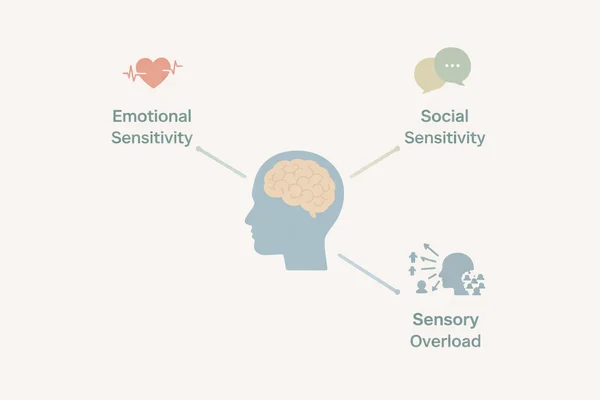
Emotional Sensitivity: Feelings Spike Fast
This can look like tears, sudden sadness, or a fast wave of panic or shame. It often shows up when feelings move quicker than your coping tools.
Common signs:
- You feel “flooded” and can’t find words.
- Your chest feels tight, your throat closes, or you get shaky.
- You need a pause before you can talk.
Best first move: calm your body first. Then decide what the emotion is asking for (rest, reassurance, space, clarity).
Social Sensitivity: Words and Tone Land Hard
This can look like replaying conversations, reading between the lines, or feeling a comment as rejection.
Common signs:
- You ruminate after feedback, even if it was mild.
- You feel exposed in conflict.
- You over-explain to prevent being misunderstood.
Best first move: separate information from meaning. Then use a boundary phrase that buys time without escalating.
Sensory Overload: Crowds, Noise, Busy Days
This can look like irritability, fatigue, or numbness after stimulation. It’s less about “being dramatic” and more about input load.
Common signs:
- You feel drained after loud places, multitasking, or constant screens.
- You get headaches, tension, or restlessness.
- You need quiet to think clearly again.
Best first move: reduce input and plan recovery. Sensory overload often improves when your environment becomes simpler.
Why Do I Cry Easily When I’m Overwhelmed?
Many people who ask why am I so sensitive also notice they cry easily. Crying can be a release, and it can be a sign you’re overloaded.
Instead of treating tears as a problem to suppress, treat them as a signal. The goal is to understand what your system is reacting to.
Why Crying Can Happen Even When You’re Not That Sad
Sometimes you cry because you’re tired, stretched thin, or holding a lot together.
Try this quick scan:
- Body: Have I slept, eaten, and hydrated enough today?
- Load: Have I had any real downtime this week?
- Emotion: Am I carrying something I haven’t named yet (hurt, disappointment, fear)?
Often, tears show up when your body finally has permission to release. That’s not weakness—it’s feedback.
Flooding: When Feelings Outpace Coping
Flooding is when emotions rise faster than your ability to steady yourself. It can feel like your brain goes offline.
If that fits, don’t force a deep talk in the moment. Instead, aim for stabilize → name → choose:
- Stabilize your body.
- Name one emotion.
- Choose one next step.
This reduces the “I’m out of control” feeling and makes coping realistic.
Two-Minute Reset: Body-First Strategies
Try this when you feel close to tears:
- Exhale longer than you inhale for four slow breaths.
- Unclench your jaw and soften your shoulders.
- Name one feeling in a single word.
Then choose one tiny action: water, a snack, a brief walk, or quiet.
If you can’t do all three, do one. Small resets still count.
Why Am I So Sensitive Over Small Things?
If you keep thinking why am I so sensitive over small things, the “small thing” may be the last straw. Your reaction often makes more sense when you look at the bigger load.
The goal here is not to shame the reaction. It’s to find the hidden pressure behind it.
The Load Effect: Stress Stacks Up
Stress stacks. Over time, your system has less flexibility. Then a small comment can tip you over.
You may be in a “stacked load” season if:
- You’re more irritable than usual.
- You recover slower after normal days.
- You feel like everything takes extra effort.
When that’s true, the fix is often capacity-building: reduce demands, increase recovery, and simplify choices.
Can Stress, Burnout, or Lack of Sleep Make Me Feel More Sensitive?
Yes, it can. When you’re tired or burned out, you have fewer resources to regulate and recover.
If sensitivity is worse recently, check for:
- Sleep debt (even one hour less per night adds up)
- Constant urgency (no true “off” time)
- Over-commitment (too many emotional responsibilities)
This isn’t a moral failure. It’s a systems problem. Adjusting load is a valid form of self-care.
A Quick Self-Check: Needs vs. Noise
Before you analyze the moment, ask:
- What do I need right now (food, rest, reassurance, space)?
- What is just noise (doom loops, imagined meanings, extra details)?
Then take one action that lowers load. Even a small change can reduce the intensity of your reaction.
Why Am I So Sensitive to What Others Say?
When other people’s words land hard, why am I so sensitive can feel personal. It helps to separate information from threat.
The goal isn’t to become unbothered. It’s to become steadier and more selective about what you absorb.
Why Words Can Feel Like Threat Signals
Tone and criticism can feel like rejection, not just feedback. If you value connection, your brain may treat social cues as high priority.
A useful reframe:
- “This comment is information.”
- “My body is reacting to what it might mean.”
- “I can pause before deciding the meaning.”
That pause is power. It stops one sentence from becoming a story about your worth.
Rumination vs. Reflection: How to Tell
Reflection asks, What can I do next time? Rumination asks, What’s wrong with me?
If you’re stuck, try a 30-second pivot:
- Write the comment in neutral words.
- Write one boundary or request you wish you had made.
- Choose one next action (rest, clarification, or a calmer follow-up).
This turns spinning into learning.
Boundary Phrases That Don’t Escalate Conflict
Try short lines like:
- I hear you. I need a minute to think.
- I can take feedback better when it’s calm.
- Let’s try again with a softer tone.
If you struggle to say them out loud, practice them in a calm moment. The words come easier when your body already knows the script.
Why Does Yelling Affect Me So Strongly?
Raised voices can trigger a stress response, even when you want to stay logical. Your first goal is to steady your system.
You don’t need to win the argument while your nervous system is on high alert. You need time and safety first.
The Nervous System Response to Raised Voices
You might freeze, want to leave, over-apologize, or snap back. These reactions can be protective.
If yelling affects you strongly, it may help to remember:
- Your reaction is fast because your body is prioritizing safety.
- You can be sensitive and still set firm boundaries.
- You can pause without abandoning the relationship.
A Pause Script for Heated Moments
Pick one sentence and repeat it:
- I want to talk, but not while we’re yelling.
- I’m getting overwhelmed. I’ll come back in 20 minutes.
If you can, add one practical anchor:
- “Let’s talk in the kitchen, not in the hallway.”
- “Let’s sit down and lower our voices.”
Small structure reduces emotional chaos.
Aftercare: How to Recover After Conflict
After yelling, don’t demand instant normal. Give your body a bridge back.
Try:
- Water + a slow exhale
- Two minutes of movement
- A quiet, predictable activity (shower, tea, tidy one small area)
Then, if you want to repair, choose one sentence:
- “I’m ready to talk again. Can we keep it calm?”
What Can I Do in the Moment When I Feel Flooded?
When sensitivity becomes a full-body wave, you need a simple plan. Here’s a small emotional first aid kit.
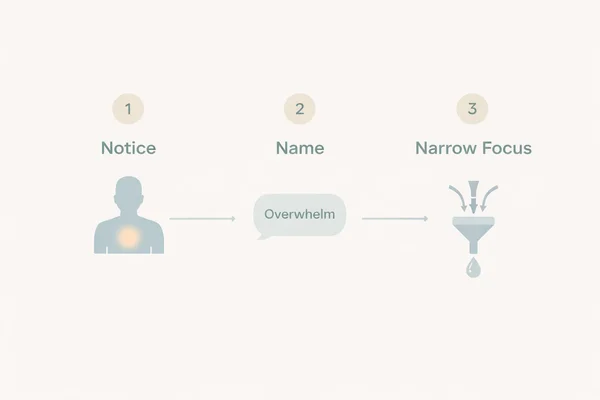
3-Step Reset: Notice, Name, Narrow Focus
Notice your body speeding up. Name it as overwhelm. Narrow to one next action only.
To make it easier, try this format:
- Notice: My chest feels tight.
- Name: This is overwhelm.
- Narrow: One step—water, bathroom, or quiet.
This keeps you from stacking decisions when your brain is already overloaded.
Grounding Through Senses (Non-Triggering)
Pick one option and do it for 30–60 seconds:
- Press your feet into the floor and feel the pressure points.
- Hold something cool (a glass, a cold pack, a metal key).
- Look for five neutral objects and name them quietly.
- Sip water slowly and focus on the sensation.
Grounding works best when it’s simple. The goal is not to feel amazing. The goal is to feel stable enough to choose your next step.
What to Avoid When You’re Flooded
Avoid these common traps:
- Long explanations (you may spiral)
- Big decisions (you may regret them)
- Re-reading messages (it adds fuel)
Instead, delay. Reset. Then return when you have more capacity.
How Do I Build Resilience Without Numbing Myself?
If you’re asking why am I so sensitive and you want to toughen up, you’re often asking for resilience. The goal isn’t to feel less. The goal is to recover faster and stay kind to yourself.
Resilience = Recovery Speed, Not Less Feeling
You can feel deeply and still return to baseline sooner. That’s skill, not personality surgery.
A resilient pattern looks like:
- You notice early warning signs.
- You use a tool before you crash.
- You repair quickly after stress.
That’s a learnable path.
How Can Sensitivity Be a Strength—not Just a Struggle?
Sensitivity can support empathy, deep focus, and strong intuition. It can also help you catch problems early.
To protect strengths, pair them with boundaries:
- Depth needs downtime.
- Empathy needs limits.
- Intuition needs verification (ask, don’t assume).
This keeps sensitivity from turning into constant exhaustion.
Daily Habits That Lower Overwhelm
Pick two habits for two weeks:
- Reduce stimulation on purpose (fewer tabs, fewer notifications).
- Schedule short recovery breaks before you crash.
- Protect sleep like it’s part of your coping plan.
- Add a transition ritual (a short walk, a shower, quiet music).
Small routines lower the baseline. When your baseline is calmer, your reactions feel less extreme.
Communicating Needs Without Apologizing
Try one clear sentence:
- I need a calmer tone to stay present.
- I can do this better with more time.
- I’m sensitive to noise. Can we lower it?
Then stop talking. Let the sentence land. Over-explaining often comes from anxiety, not necessity.
A 7-Day Trigger and Recovery Tracker You Can Copy
Tracking turns confusion into clarity. One note a day is enough.
If you want a simple format, use three lines:
- Trigger:
- Body signal:
- Recovery step:
Day 1: Biggest Emotional Trigger
Write what emotion hit hardest and what happened right before it. Add one line: What did I need in that moment?
Day 2: Biggest Social Trigger
Write what comment, tone, or interaction stuck with you. Add one line: What boundary would have helped?
Day 3: Biggest Sensory Trigger
Write what environment drained you (noise, pace, crowds, screens). Add one line: What small environmental change can I try next time?
Day 4: My Earliest Warning Signs
Write the first clue you were heading toward overwhelm. Examples: jaw tightness, rushing thoughts, urge to withdraw, irritability.
Day 5: What Helped Me Recover
Write what actually helped, even a little. Be specific: “ten minutes alone” is clearer than “rest.”
Day 6: My Boundary I Avoided
Write the boundary you wish you had set. Keep it small: one request, one limit, one pause.
Day 7: One Change to Try Next
Write one small change you’ll try next week. Aim for “easy wins,” not perfect life redesign.
When Should Sensitivity Prompt Extra Support?
This article is for education and self-understanding. It isn’t medical advice, and it can’t tell you what diagnosis you do or don’t have.
If sensitivity is making life feel unmanageable, extra support can help. You don’t need to wait until things are unbearable.
Function Check: Work, School, Relationships
Consider extra support if sensitivity regularly:
- Disrupts work or school
- Causes frequent shutdown or conflict
- Leaves you exhausted most days
- Makes you avoid life to stay stable
This is not a test you have to “pass.” It’s a way to notice when coping alone isn’t working.
Self-Reflection vs. Professional Evaluation
Self-reflection helps you name patterns and try coping tools. Professional evaluation helps when you need deeper assessment or structured treatment planning.
If you’re unsure, you can start with self-reflection. If distress stays high or function keeps dropping, a professional can help you sort what’s going on with more support.
What to Look for in Supportive Help
Look for someone who:
- Respects your pace
- Avoids shaming emotions
- Helps you practice skills, not just analyze
- Works collaboratively on boundaries and regulation
Good support should make you feel more capable, not more judged.
How Can an HSP Self-Assessment Help Me Take the Next Step?
After you’ve explored why am I so sensitive, it can help to organize what you learned. A self-assessment can be useful as an educational reflection tool, not a diagnosis.
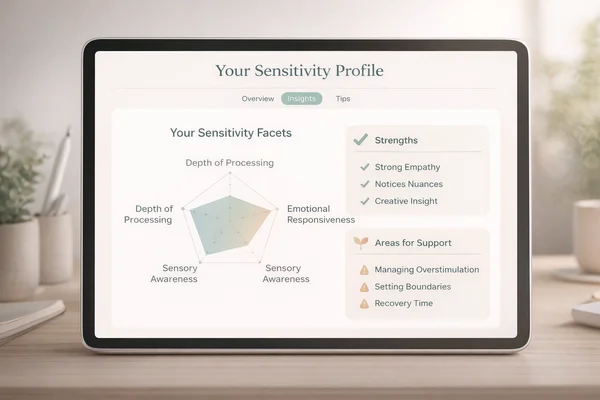
Why Self-Reflection Is the Safest Next Step
Self-reflection moves you from Why am I like this to What helps me. It turns vague discomfort into patterns you can work with.
If you’ve been overwhelmed, structure can feel soothing. It reduces guesswork.
Introducing Our HSP Self-Assessment (Educational Tool)
If you want structure, you can explore our HSP test online. Use it to map patterns and put language to your experience. It’s optional.
If you try it, treat the result like a mirror. It can help you reflect. It shouldn’t be used to label yourself permanently.
What You’ll Learn: Strengths, Challenges, Action Ideas
A structured self-assessment may help you:
- Name your strongest sensitivity channel
- Spot common triggers
- Identify strengths that come with depth
- Choose coping steps that fit your life
This is especially useful if your experience feels “real” but hard to explain.
Optional Deeper Insights (No Promises)
If you use deeper insights, treat them as suggestions, not guarantees. The most helpful mindset is: “Does this match my life, and does it give me a next step?”
If it doesn’t fit, you can ignore it. That’s part of using tools safely.
What a Self-Assessment Can and Can’t Tell You
A self-assessment can:
- Organize patterns
- Give you language
- Suggest next steps
It can’t:
- Diagnose or confirm a condition
- Replace professional care
- Predict your future
Used this way, it supports your self-understanding without making medical claims.
Next Steps for Living Well With Sensitivity
If you’ve been stuck on why am I so sensitive, try one small step today: use the 3-step reset once, track triggers for seven days, or set one boundary around tone, time, or noise.
If you want another resource, you can review HSP test results explained to see how people turn reflection into action. And if sensitivity is disrupting daily life or safety, consider reaching out to a licensed mental health professional.
Frequently Asked Questions
How to stop being a sensitive person?
You usually don’t need to erase sensitivity. Instead, reduce overwhelm and recover faster.
Start small:
- Protect sleep and food basics.
- Use one repeatable reset (like the 3-step method).
- Set one boundary around tone or time.
Those changes often help more than trying to force yourself to be different.
What causes a person to be highly sensitive?
High sensitivity can be a natural trait. It can also feel stronger when stress, poor sleep, or repeated overwhelm lowers your capacity. If you’re unsure what’s driving your sensitivity, the Sensitivity Map plus a week of tracking can make patterns clearer.
How can I become more resilient without shutting down my feelings?
Resilience is not numbness. It’s the ability to recover.
Try:
- Body-first calming tools in the moment
- Lowering daily overload (stimulation and commitments)
- Clear, simple boundaries you can repeat
Over time, you can stay emotionally open without feeling constantly flooded.
Why am I so sensitive to what others say?
You may react to meaning and connection, not just words. Rumination can also keep comments alive. Try separating information from meaning, then choose one response: clarify, set a boundary, or let it pass without turning it into a story about your worth.
Why am I so sensitive when someone yells at me?
Raised voices can trigger a quick stress response. A pause script and a boundary around tone can protect you while you decide what to say next. If yelling is frequent in your environment, support and boundaries may matter even more.
What’s the difference between self-reflection and clinical assessment?
Self-reflection helps you name patterns and try coping tools. Clinical assessment supports deeper evaluation and treatment planning. If sensitivity comes with persistent distress, loss of function, or safety concerns, professional support may help.
What can a self-assessment tell me—and what can’t it tell me?
A self-assessment can organize patterns and suggest next steps. It can’t diagnose or confirm anything, and it can’t replace professional care. Use it as a structured reflection tool, not as a final answer about who you are.